A curriculum drawn from across UC San Diego.
The MDes is a two-year, full-time graduate degree for people who want to become design leaders and work on wicked problems. You’ll learn to frame ambiguous problems, ground decisions in research and evidence, prototype real solutions, and lead the teams that carry them forward. What sets the program apart is its focus on judgment. Real problems arrive with shifting constraints, competing stakeholders, and incomplete information. You build judgment by working in those conditions: knowing when to dig deeper, when to move quickly, and which tradeoffs matter most.
The program is housed in the Design Lab at UC San Diego, whose faculty span cognitive science, engineering, medicine, public health, economics, and more. You’ll learn to draw on methods, tools, and perspectives from across the university to lead teams that do the same.
Who should apply:
The MDes is for early-career and early-to-mid-career professionals motivated by intellectual growth and ready to expand their impact. Strong candidates arrive from engineering, the social sciences, public health, architecture, and the arts. You don’t need to be an expert designer, but be ready to become one.
Curriculum: People-centered, making and doing, and room to customize.
The MDes curriculum moves through three stages: a shared foundation, a deepening core, and a culminating project or thesis. Required courses focus on understanding people and the practice of making. Electives, drawn from across UC San Diego, can be customized to support future career goals .
Sample Plan of Study:
Numbers in parentheses are course units, e.g. DSGN 200 (4). The MDes requires a minimum of 72 units.
Year 1: Foundation.
Students arrive from different fields. Year 1 builds a shared language: human-centered design, prototyping, research methods, and systems thinking. By the end of Year 1, students are working like designers, regardless of where they started.
|
Fall |
Winter |
Spring |
|
DSGN 200 (4) Design of Everyday Things |
DSGN 201 (4) Human-Centered Design & Complex Sociotechnical Systems |
Elective (4) |
|
DSGN 100 (4) Prototyping |
DSGN 261 (4) Advanced Design Project |
Elective (4) |
|
Elective (4) |
DSGN 430 (4) Introduction to Academic Design Research |
Elective (4) |
|
DSGN 219 (2) Design@Large |
Year 2: Depth and application.
Advanced studio practice, humanistic research, and socio-technical systems. Culminates in either a Capstone project with a real sponsor organization, or a faculty-mentored Research Thesis.
|
Fall |
Winter |
Spring |
|
DSGN 200 (4) Design of Everyday Things |
DSGN 201 (4) Human-Centered Design & Complex Sociotechnical Systems |
Elective (4) |
|
DSGN 100 (4) Prototyping |
DSGN 261 (4) Advanced Design Project |
Elective (4) |
|
Elective (4) |
DSGN 430 (4) Introduction to Academic Design Research |
Elective (4) |
|
DSGN 219 (2) Design@Large |
Foundational Sequence:
Year 1 opens with a shared foundation. A common language for a cohort arriving from different disciplines. These courses establish the core methods and mindset of the program.
Core courses:
Electives let students go deep in the domains that matter most. Design-specific electives are highlighted below.
Elective courses:
Electives let students go deep in the domains that matter most. Design-specific electives are highlighted below.
Additional electives are drawn from graduate offerings across UC San Diego in cognitive science, engineering, management, public health, urban studies, and more. A full list of eligible electives will be published here.
Two years of learning. Project-based application to bring it together.
Two years of learning. Project-based application to bring it together.

Plan A: Capstone
The Capstone Track is the spine of the MDes: a chance to put the full program to work on a real problem, for a real organization, under real constraints.
Over two quarters, teams take on a challenge brought to the program by a sponsor organization (a business, government agency, or NGO), moving from problem-finding in the first quarter to solution-finding in the second. Working under faculty guidance, students leave with portfolio-ready work, experience navigating real organizations, and sponsor relationships that can launch a career.

Plan B: Thesis
The Thesis Track is for students who discover, through the MDes, that their interests run deeper into academic design research than into immediate practice.
Thesis students replace the two-quarter capstone with two quarters of directed research, working closely with a faculty advisor and evaluated by a committee of three faculty members. All other program requirements remain the same. The Thesis Track is available by petition, and students typically find their way to it through DSGN 430: Introduction to Academic Design Research.
Studio Culture & Community
Much of what makes the MDes valuable happens between classes. Cohorts are small and deliberately curated across disciplines, so students learn as much from the engineers, social scientists, public health researchers, and designers beside them as from any syllabus.
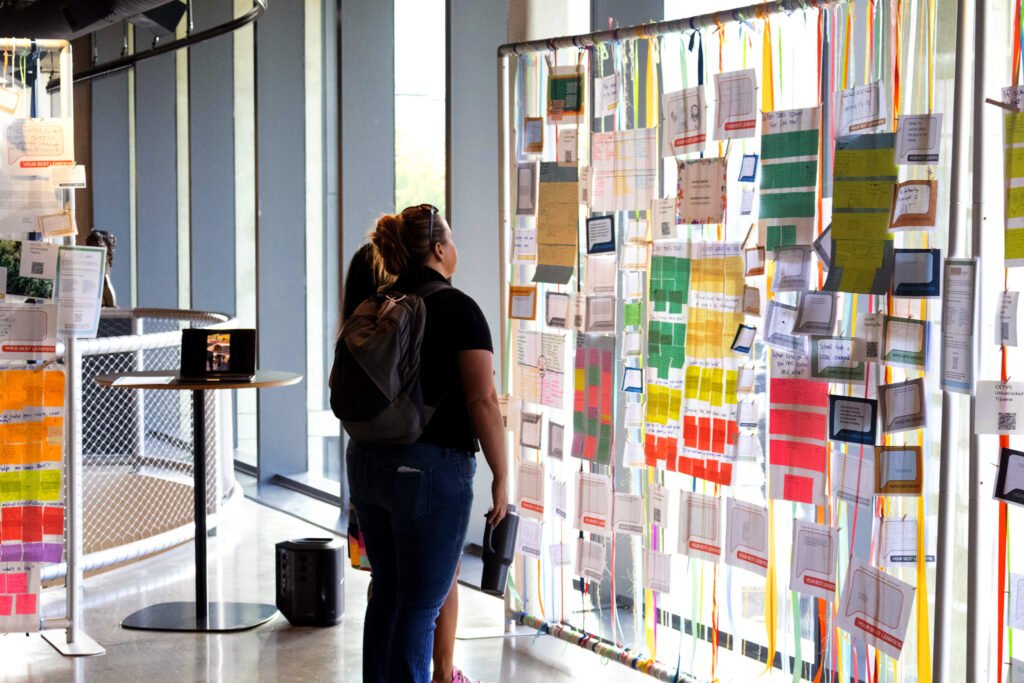
Most of that learning happens in place. Students work day to day in the Design and Innovation Building’s studio spaces and makerspace, with room to prototype, critique, and think alongside peers and faculty. The mentorship and relationships formed there are not extras. They are central to the education.
Faculty research is part of that environment. Students are encouraged to join faculty-led research, one of the highest-leverage experiences for shaping a design career.
Where the MDes Leads
The MDes is built to be a career accelerator, not only an education. Graduates are prepared to step into design leadership roles such as Design Director, VP of Design, and Chief Design Officer, across industry, government, startups, and nonprofits.
Industry connection runs through the program. The Capstone pairs teams with real sponsor organizations, and the program is building partnerships, sponsored projects, and an industry speaker series so students gain repeated, real-world experience before they graduate.
Because relationships and networks shape so much of where graduates land, the program treats career mobility as something it actively builds: career navigation, mentorship, and a growing network of faculty, industry partners, and alumni to draw on.